Smart Drag-Sail
Deorbit System
An AI-optimised drag sail that triples deorbit speed by timing deployment to solar weather peaks.
High solar flux detected.
Mission concept
The problem
A 6U CubeSat at 600 km SSO takes 25+ years to naturally deorbit — violating ESA's 5-year Zero Debris rule.
The solution
AI-optimised drag sail increases area 10× and deploys at solar max, cutting deorbit to <5 years with zero propellant.
Mission lifecycle
Five-phase lifecycle spanning ~9 years. Click phase dots to expand details.
Sail mechanism
AI module
LEOP checkout
Sail stowed
Solar Wx ingest
AI model trains
AI picks window
Drag area ×10
Aerobraking
✓ ESA 5-yr rule
🛸 DECOMMANDER: SOLAR SURFER
AI deployment decision logic
The onboard AI ingests NOAA F10.7 data and predicts atmospheric density via NRLMSISE-00. The mini-game simulates this: timing clicks with solar wave peaks yields maximum score — just like real AI decision logic.
Orbital decay simulation
🔬 Python‑driven atmospheric drag simulation (NRLMSISE‑00). AI-optimised scenario times sail deployment to solar flux peak.
3D Orbit Decay Race
Why this exists
The same satellite, three deorbit strategies, racing the ESA 5-year clock:
- ⬤ Grey — Baseline: no sail. Decays naturally over ~37 years. ESA-illegal.
- ⬤ Orange — Naive: sail deploys at end-of-mission. Decays in ~5 years post-EOM.
- ⬤ Green — AI: same hardware, AI Inference IC picks the deploy day from a probabilistic solar forecast.
Altitude shown 5× exaggerated for visibility. Drag scene to rotate, scroll to zoom.
Time
Strategies (click to toggle)
Hardware Architecture
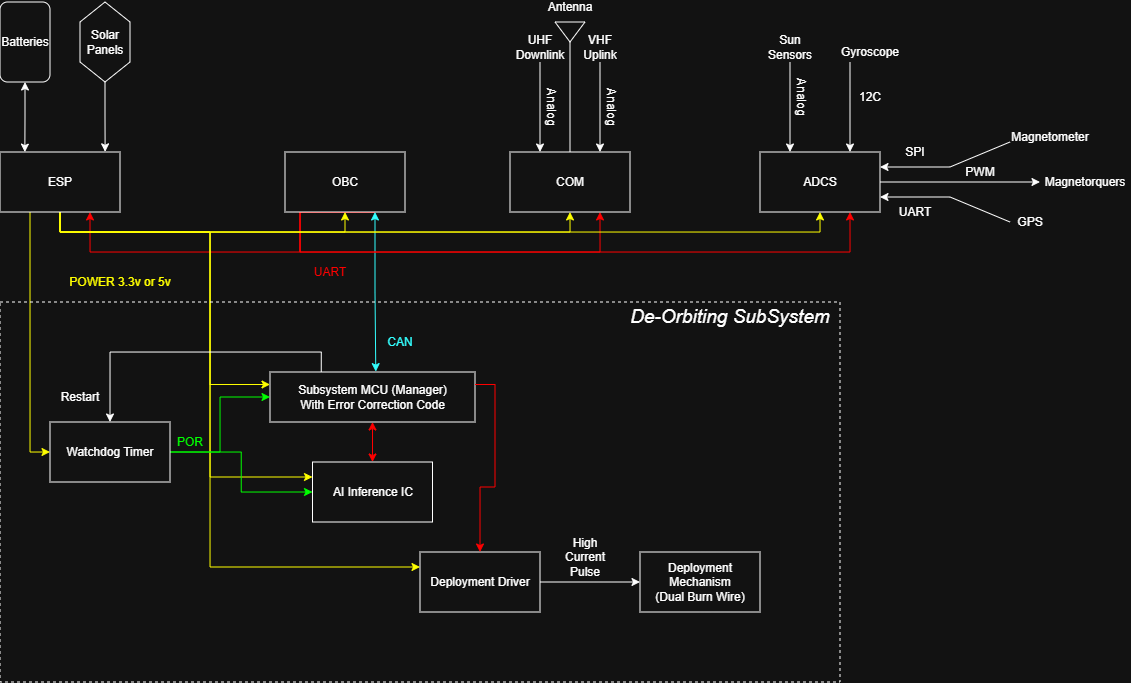
Subsystem components
- Subsystem MCU (Manager) — ECC RAM, supervises the IC and arms the Deployment Driver. Communicates with OBC over CAN.
- AI Inference IC — runs the distilled deployment policy (decision tree, ≤1 KB C). Movidius Myriad 2 / Coral / Akida class.
- Watchdog Timer — POR + Restart on IC lock-up; mandatory for COTS parts in radiation environments.
- Deployment Driver — high-current burn-wire pulse output, electrically isolated from low-power logic.
- Deployment Mechanism — non-pyrotechnic burn wire releases the ADEO-class sail cassette.
Bus integration
- CAN bus → OBC — telemetry up, command authority retained on ground until autonomy is enabled.
- Power 3.3 V / 5 V from ESP — protected rail, fused at the subsystem boundary.
- F10.7 source — ground uplink (NOAA SWPC 27-day outlook) refreshed daily, with 27-day persistence as fallback.
- Altitude/state — from the GPS receiver via ADCS, forwarded to the IC each orbit.
Distilled flight policy (auto-generated C)
Emitted by flight_policy.py via the m2cgen library, distilling the full ground-segment Gaussian Process + robust optimization pipeline into a single function. Cross-compile for the IC of choice. No runtime, no allocations, no dependencies — just a sequence of comparisons.
// Loading flight/policy.c …
KPIs & compliance
| KPI | Definition | No sail | Naive sail | AI-optimised |
|---|---|---|---|---|
| Post-mission lifetime | Years from mission end to reentry | 25+ yr | ~8 yr | <5 yr |
| ESA 5-yr compliance | Meets ESA Zero Debris Charter §3.1 | No | No | Yes ✓ |
| Deorbit probability (95th) | P(reentry within declared window) | 12% | 61% | >95% |
| TRL — AI deployment | Technology Readiness Level | N/A | N/A | TRL 4 |
📊 Interactive Compliance Estimator
Adjust mission parameters to see ESA compliance outcome.
Compliance references
Chapter 3, Rule §3.1: All spacecraft in LEO must be deorbited within 5 years of end-of-mission.
Inter-Agency Space Debris Coordination Committee guidelines. Section 5.3 defines the 25-year rule.
Used for computing atmospheric density at 600 km altitude as a function of solar flux (F10.7).
10 / 20 / 50-year impact
Prevents hundreds of dead satellites accumulating in LEO.
AI reduces deorbit duration by 40–60%.
Kessler risk remains controlled.